


Battery Endurance: The Persistent Drone Challenge
Battery life has long stood as a defining constraint in commercial and dual-use drone operations. For missions ranging from infrastructure inspection and agricultural mapping to search and rescue and military reconnaissance, flight endurance limits both operational range and payload capabilities.
Conventional lithium-ion batteries, while the current industry standard, often restrict professional drone flights to between 20 and 60 minutes under optimal conditions, with environmental factors and payload further reducing effective mission durations. This bottleneck prompts extensive logistical planning, frequent battery swaps, and limits to mission complexity.
Stakeholders worldwide are aggressively seeking solutions. Hybrid propulsions, hydrogen fuel cells, and other innovative designs have seen trials—especially for high-endurance or heavy-lift applications—but none has yet emerged as a universally practical, scalable answer to the drone endurance dilemma.
The urgency for better solutions is heightened as regulatory agencies prepare to regularize beyond visual line of sight (BVLOS) drone flights, which will demand not just longer, but also safer and more reliable battery technology.
Lithium-Ion vs. Solid State: Contrasting Technologies
Lithium-Ion Batteries: Current Capabilities and Limitations
Lithium-ion batteries (Li-ion) use a liquid electrolyte to transport lithium ions between electrodes. Their chief advantages include relatively high energy-density (up to 250Wh/kg), fast recharge times, and decades of incremental improvement resulting in robust manufacturing scale and cost-effectiveness. This technology is well-understood and widely available, supporting mass adoption across the commercial drone landscape.
However, lithium-ion batteries also bring substantial drawbacks:
-
Flight times are capped by the practical energy density limits of today’s batteries.
-
Safety is an ongoing concern: the liquid electrolyte is flammable, carrying risk of “thermal runaway” and catastrophic failure, particularly in demanding environments or following impact.
-
Battery lifespan is tied to a limited number of charge cycles before performance degrades noticeably.
-
Li-ion batteries are also sensitive to extreme temperatures: cold can sap performance, while high heat raises fire risk.
Solid State Batteries: The Next Leap Forward?
Solid state batteries (SSBs) replace the liquid electrolyte with a solid one—often a ceramic, glass, or polymer matrix—enabling a fundamentally different architecture. According to a recent report by Persistence Market Research, solid state batteries promise energy densities of over 400Wh/kg, and some sources cite even greater potential. This leap theoretically allows drones to fly longer and/or carry more equipment for a given battery weight. In the discussion of Lithium-Ion vs. Solid State battery technology for drones, these points carry weight.
Key advantages highlighted in industry reports and research include:
-
Substantially higher energy density: SSBs could double or triple commercial drone range, enabling multi-hour flights that are well beyond today’s Li-ion capabilities.
-
Improved safety: The solid electrolyte is non-flammable, sharply reducing the risk of fires and explosions—a significant consideration for operations over populated or sensitive areas.
-
Longer lifespan: SSBs resist degradation over thousands of charge-discharge cycles, potentially lessening total cost of ownership for fleet operators—including both commercial and military users.
-
Superior performance in extreme temperatures: Solid electrolytes are more robust under Arctic or desert conditions, broadening drone deployability for critical missions.
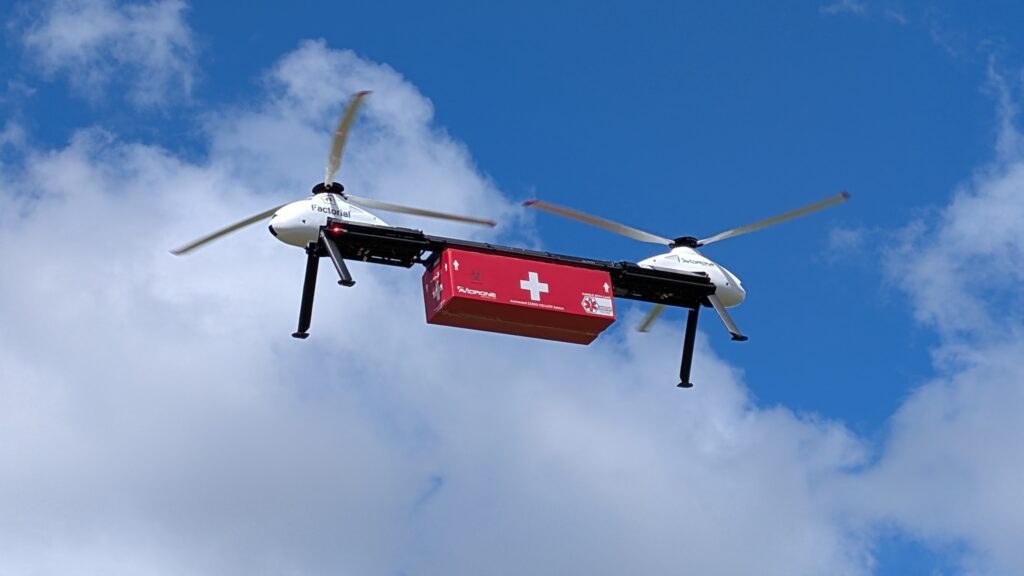
Notably, Factorial Energy recently announced delivery of its first solid state battery cells to Avidrone Aerospace for integration into high-end endurance drones. Testing projects these batteries could “double the range” of existing models without adding weight, and withstand both high-altitude and temperature extremes, says Factorial.
Drawbacks and Commercialization Barriers
Despite their potential, SSBs are not without present-day limitations:
-
Manufacturing complexity and cost: SSBs remain expensive to produce at scale and involve new supply chains, making them less accessible for the mass market currently dominated by Li-ion cells.
-
Slower charging speeds: While research efforts (such as this recent publication by scientists at UC Riverside) are closing the gap, most SSBs still lag Li-ion in recharge times due to interfacial resistance between the solid electrolyte and electrodes.
-
Technology readiness: Although early field tests (such as with Avidrone) show promise, widespread commercial deployment awaits further industrial scaling and proof of long-term reliability in diverse drone platforms.
The Road Ahead: Regulatory and Industry Implications
As BVLOS rules come into effect, the strategic importance of battery technology grows. Longer endurance enabled by SSBs could unlock genuinely autonomous logistics, persistent surveillance, rapid-response emergency missions, and more—all with improved safety margins.
However, for SSBs to fully realize their promise, industry players will need to overcome production challenges, drive down costs, and validate performance under regulatory scrutiny. According to research and industry commentary, it is only through large-scale rollouts and continued R&D investment that SSBs will transition from breakthrough innovation to industry standard.
Powering the Next Chapter in UAVs
Solid state batteries are poised to fundamentally transform the drone sector, with the potential to dramatically extend endurance and mission capability for commercial and dual-use platforms. While traditional lithium-ion batteries will remain essential for the foreseeable future due to their cost and availability, the arrival of SSBs signals a compelling new chapter in aerial mobility—one that could redefine what is possible when drones are no longer tethered by the short leash of battery life.


Miriam McNabb is the Editor-in-Chief of DRONELIFE and CEO of JobForDrones, a professional drone services marketplace, and a fascinated observer of the emerging drone industry and the regulatory environment for drones. Miriam has penned over 3,000 articles focused on the commercial drone space and is an international speaker and recognized figure in the industry. Miriam has a degree from the University of Chicago and over 20 years of experience in high tech sales and marketing for new technologies.
For drone industry consulting or writing, Email Miriam.
TWITTER:@spaldingbarker
Subscribe to DroneLife here.